

Introducing mathematics in Preschool and Year 1
Abstract
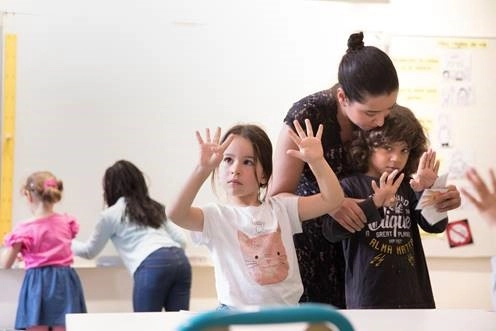
This CSEN publication aims to extract, among the results of research in cognitive science, those that appear useful for teaching mathematics in kindergarten and elementary school. These results mainly encourage the introduction of mathematics teaching through play and the construction of material objects.
The state of research in this field is such that it is rarely a case of ready-case formulas, which can be directly applied to the classroom. It is therefore up to teachers to take hold of them in order to translate them into their practice in the way that seems most relevant to them. These proposals could, in turn, be subject to rigorous assessments of their impact on students.
- In preschool, all areas of mathematics can be introduced through play and the construction of tangible objects.
- Introducing children to the enjoyment of mathematics means engaging them not only with numbers, but also with construction activities, shapes, measurement, spatial reasoning, maps, puzzles, logic, and sets.
- To facilitate the transition to abstract thinking, teachers should revisit the same mathematical concept regularly (for example, the contrast between two and three, or the concept of an even number), while approaching it from different perspectives and varying the games and learning contexts.
- Even more advanced concepts, such as numbers beyond twenty or fractions (half, one-half), can be introduced at an early stage and revisited in progressively greater depth each year, following a spiral approach.
- Mathematical thinking relies on a rich and specific vocabulary, which teachers should use consistently across all mathematical activities by thinking aloud and making their reasoning explicit.
- Regular assessment, even through very simple tasks (Can the child produce three objects? Does the child understand before and after, above and below?), helps teachers adapt instruction more effectively to children’s learning needs.
This text was written by Stanislas Dehaene, with contributions from Anne Christophe, Ghislaine Dehaene-Lambertz, Véronique Izard, Elena Pasquinelli and Elizabeth Spelke.
On the same topic
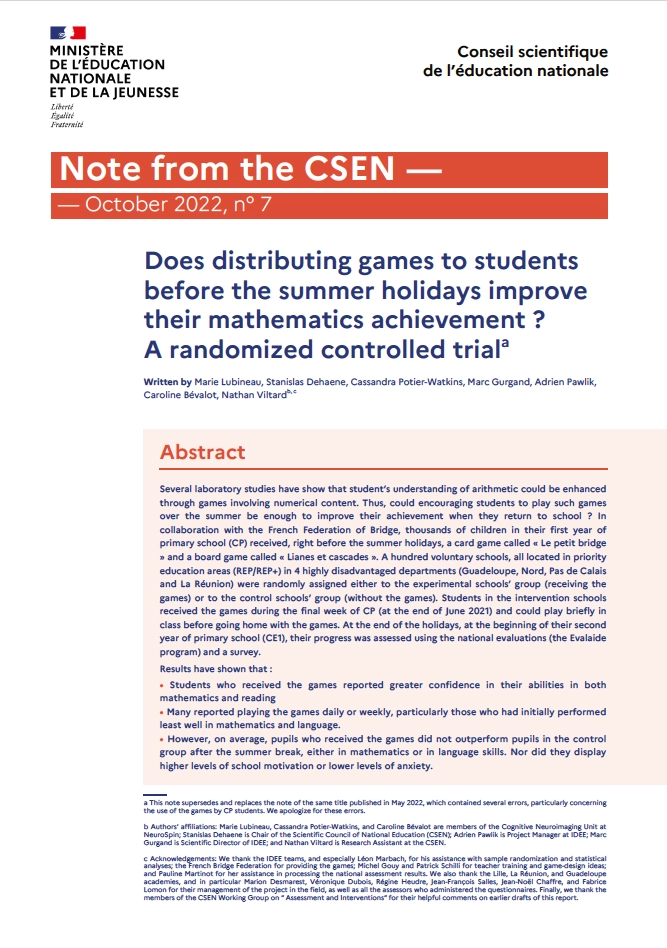
Does distributing games to students before the summer holidays improve their Mathematics achievement ?
Note from the CSEN n°7 - A randomized controlled trial - English translation
Sur la même thématique
MathAData pour enseigner les mathématiques appliquées avec des défis d'IA - Stéphane Mallat & Miguel Toquet
Forum Education - 30 septembre 2026
Introduction & Pionniers des maths - Stanislas Dehaene & Heidi Budon-Dubarry
Forum Education - 30 septembre 2026