

Abstract
How can we stimulate an interest in mathematics from an early age? In early childhood education, children are often asked to create or complete patterns, such as threading a yellow bead, then a red one, then a yellow, then a red, and so on, on a necklace. These activities are sometimes seen as exercises to develop fine motor skills, writing, or artistic expression. However, we demonstrate that they are primarily a powerful stimulus for the development of mathematical skills, particularly in geometry and logic.
Indeed, the study of patterns leads children to form numerical and geometric abstractions that they can transfer from one domain to another. Recognizing the same pattern in a sequence of musical notes and in a row of beads draws the child’s attention to the abstract properties of numbers, symmetries, rules, and written notations. This is why we propose making pattern-based activities more systematic in early childhood and the early years of primary education, and we present a hierarchy of activities that can be used in the classroom.
Written by Lorenzo Ciccione and Stanislas Dehaene
On the same topic
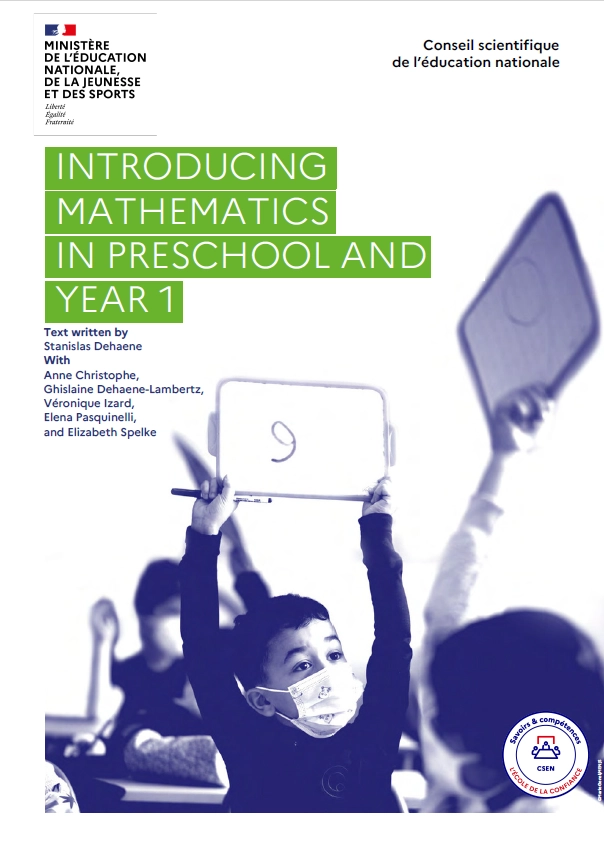
Introducing mathematics in Preschool and Year 1
Summary of research and recommendations - English translation
Sur la même thématique

MathAData pour enseigner les mathématiques appliquées avec des défis d'IA - Stéphane Mallat & Miguel Toquet
Forum Education - 30 septembre 2026
Introduction & Pionniers des maths - Stanislas Dehaene & Heidi Budon-Dubarry
Forum Education - 30 septembre 2026